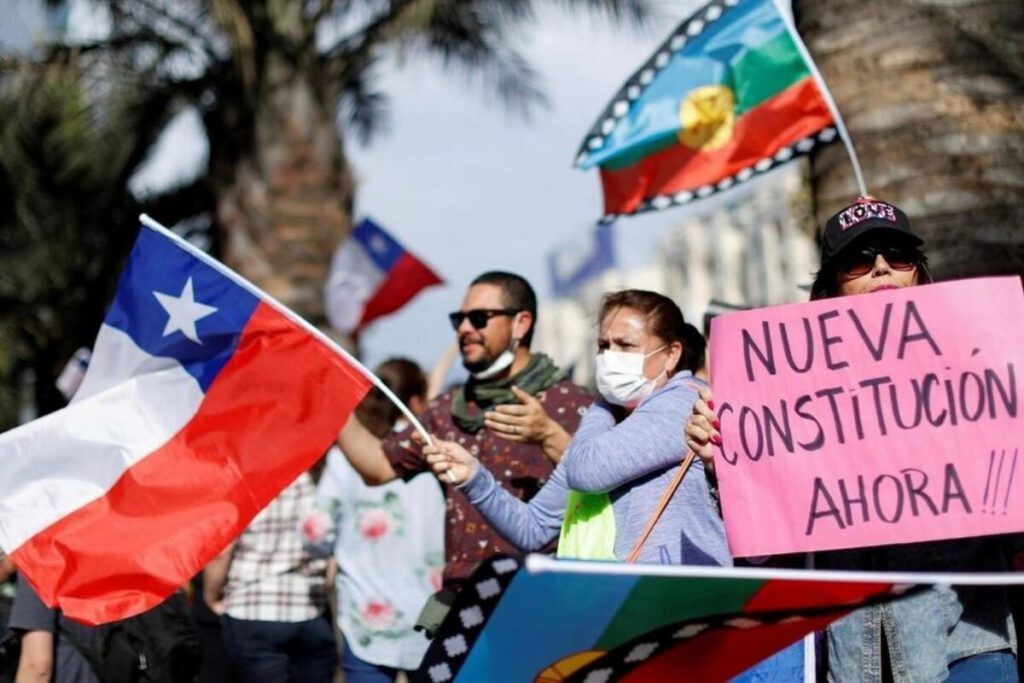
Since October 2018, Chile has changed. By an almost fortuitous event, in which some students decided to jump the toll barriers of the subway in Santiago, as a result of an increase in transport prices, was the spark for the beginning of protests throughout the country, where society demonstrated massively, in volumes not seen since the end of the Military Government.
As a conclusion, it was agreed through a plebiscite to change the current political Constitution and for this purpose the formation of a Constituyent Assembly.
The pandemic further complicated the situation. The Government had to make extra investments in mass vaccination and developed a series of bonuses that depleted the fiscal coffers and brought as an undesired consequence a lack of labor force that preferred the Government bonuses that have been similar or greater than the income they received in their jobs. This has particularly affected the private security sector, where rents are generally lower.
Also, the dissociation of the Congress and the Government led to a power struggle. Parliamentarians gradually began to give in to populist desires, achieving so far the withdrawal of 30% of the retirement funds, which left many contributors without money for their pensions. Likewise, the respective interests to which the members of Parliament respond have significantly undermined the legislative process as well as the breakdown of political agreements.
The lack of clear leadership on the part of the Government has also led to an increase in a series of conflicts, the most serious of which is the one affecting lumber producers, who have had hundreds of attacks on their property, resulting in confrontations with the public forces, with sad outcomes.
The Constitutional Convention, democratically elected, has sustained power struggles and a generalized disorder that is beginning to affect the alliances to reach agreements and advance in the drafting of a new constitutional text.
Unfortunately, the signs that the Convention has shown could structurally affect the State, causing investment analysts to suspend or definitively withdraw investments in the country, due to the uncertainty of the future of private property and other rights such as the use of water flows, which would have a strong impact on the national positioning before the international community.
The uncertainty and the low capacity to impose order that the Government has sustained, have also been a breeding ground for drug trafficking cartels to be incipiently operating in Chile. A few days ago, an institutional report warned that Mexican cartels have already begun to settle in the country, adding to the already existing Colombian cartels.
In November of this year, parliamentary and presidential elections are to be held, where the dispersion of ideas and political interests make it very difficult to determine the outcome. There are candidates from the extreme right, center and extreme left. The different parties and the emergence of independent leadership options do not yet allow us to draw a clear perspective.
On the other hand, the increase in the measurements regarding corruption in Chile has increased exponentially, with recurrent scandals of malicious use of public funds where the high command of the Armed Forces and the Police have been relevant actors, which has reduced their legitimacy before society.
The aforementioned ingredients are propitious to increase the levels of disorder and uncertainty that the country is going through, which could reach dangerous levels for institutional stability, given the little confidence that the Governmental Institutions and the political parties currently grant to the citizens.
Chile requires an independent and renewed statesmanship leadership, alien to party conveniences or to the different power groups, capable of restoring national development, with a transversal tendency, capable of reaching agreements to impose the rule of law and thus be able to return to the traditional order that the country had sustained for many years.
Finally, Sciat Facere recommends placing emphasis on updating the process of corporate risk management, in order to be able to adopt the necessary measures to allow the continuity of their respective interests in Chile. This opinion article contains only an incipient analysis of the facts, which must be deepened in order to achieve risk mitigation proposals.
Sciat Facere. «We know how to do».